By: Émilie Parent-Bouchard, Local Journalism Initiative, Unpointcinq
The first national park managed by an Indigenous community, the first inhabited national park, the first national park to authorize—even promote—hunting, fishing, and trapping: in this larger-than-life territory, half measures are not taken. After years of patience, the efforts of the Cree Nation of Mistissini are finally bearing fruit.
With a mixture of humility and pride, Deputy Chief John S. Matoush acknowledges the work of the elected officials who preceded him in reaching this “long-awaited” milestone.
John S. Matoush, Vice Chief of the Mistissini Cree Nation.
The creation of a park has been in the works since… the signing of the James Bay and Northern Quebec Agreement (JBNQA) in 1975. Chapters 22 and 24 established specific regimes for environmental protection and for hunting, fishing and trapping.
Signed in the early 2000s, the Paix des Braves reiterated this commitment, once again promising to achieve the highest legal status for the conservation of the territory, namely the establishment of a national park.
Protecting the “Cree Way of Life”
“We have come a long way to get to where we are today: to be recognized as decision-makers and direct actors in the park project. And what makes it unique is that our rights regarding trapping, hunting and fishing are preserved. We will also offer ecotourism activities. But this is an additional level of protection: it prohibits any exploitation of resources, including mining, hydroelectric or forestry,” he reminds us.
Because even though the area encompassed by this 28th national park is vast—over 12,000 km²—it has been frequented by Cree families for millennia. The tallymen, the trapping masters, were consulted, as were the elders, youth, and families of the community who constantly roam the territory. They also continue to have a say in the development plan currently being drawn up, explains Mireille Gravel, a biologist hired as the executive director of Nibiischii National Park.
“The goal is to work with the people who know the territory best, and those are the people who live there. I call them ‘wildlife managers,’ that’s what their job is as trapping masters: they know their territory like the back of their hand. Thanks to them, we will be able to make a coherent and accepted development plan,” believes the woman who previously headed the Nibiischii Corporation, responsible for administering the Assinica and Lacs-Albanel-Mistissini-et-Waconichi wildlife reserves.
After a short boat trip on Lake Waconichi, cultural development officer Mario Lord was waiting for us with bannock and hot tea in his sabtuan!
It is in this last wildlife reserve, part of which will be absorbed by Nibiischii Park, that she introduces us to Mario Lord, a gentle giant in charge of developing Cree culture. He welcomes us into his sabtuan, a traditional longhouse, with bannock he has just cooked on the wood stove.
« Quand on a beaucoup de monde, on organise des activités comme le boucanage du poisson, la fabrication de petits oiseaux, d’outardes, de pochettes en cuir d’orignal », énumère le grand gaillard en pointant les amoncellements de peaux tendues, de branches courbées et d’autre matériel d’artisanat. « Et je raconte aussi des histoires de mon passé, d’où je viens. Mes grands-parents m’ont tout montré. Je n’ai pas de diplôme officiel, mais je pense que j’ai déjà obtenu celui de l’université du bois! »
Nibiischii : terre des eaux
La création du parc permettra de préserver ces connaissances traditionnelles fines, mais aussi des massifs de forêts anciennes et l’habitat d’une quinzaine d’espèces à statut précaire — dont le fameux caribou forestier.
« Nibiischii veut dire “terre des eaux” ou “terres où naissent les grandes rivières naturelles”. C’est un territoire dans les monts Otish où le réseau fluvial du nord prend sa source : la Rupert, La Grande, l’Eastmain, la Témiscamie. C’est la chose principale à protéger : le hub hydrologique du Québec », fait-elle valoir. Elle précise qu’une cinquantaine de sites archéologiques, fréquentés depuis plus de 5 000 ans pour la fabrication d’outils en quartzite de Mistassini, sont aussi dans l’enceinte du parc, dont ceux de la Colline-Blanche, classés site patrimonial et lieu historique national du Canada.
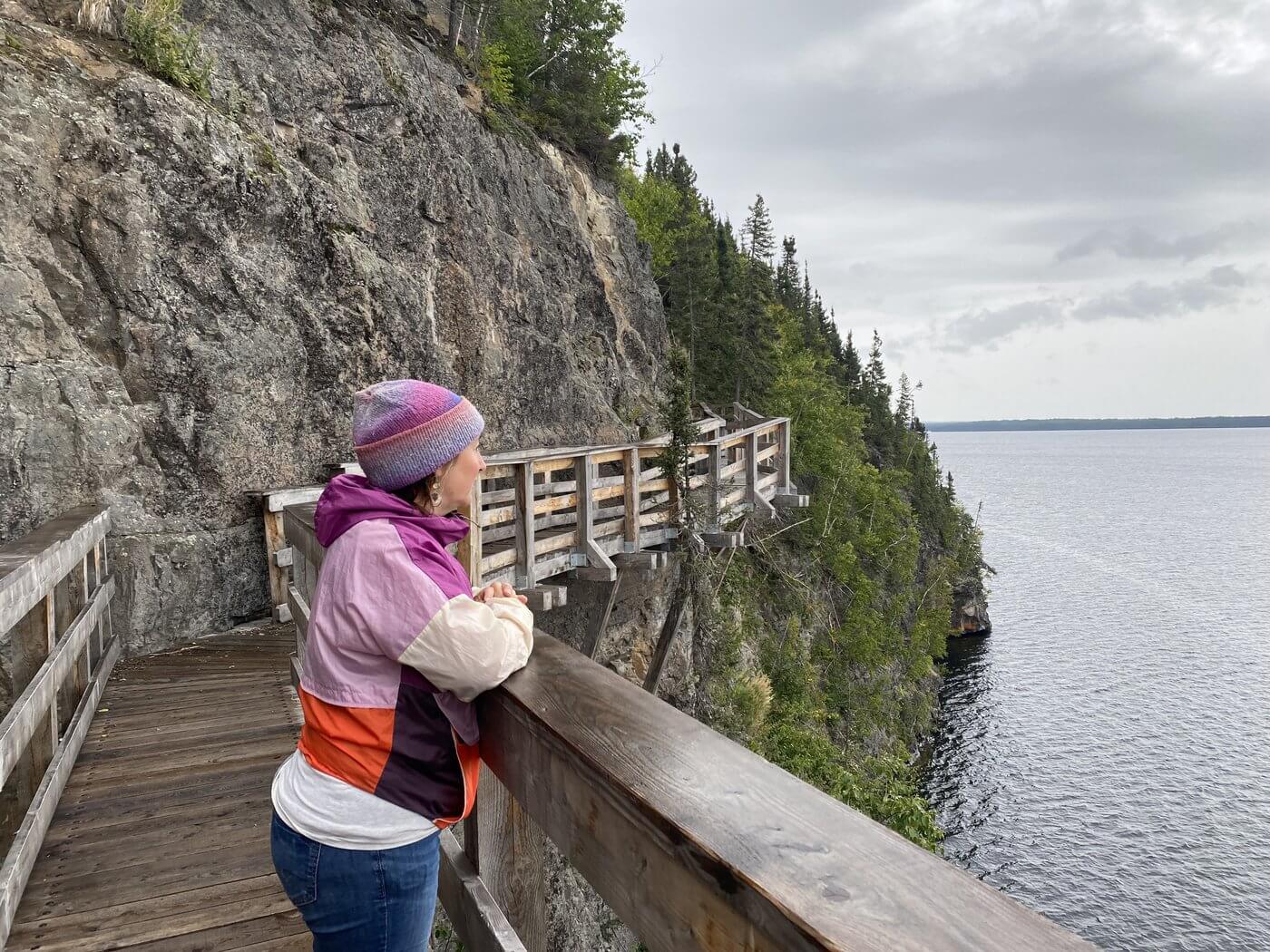
La biologiste et directrice générale du parc national Nibiischi Mireille Gravel explique qu’une fois le sentier aérien terminé, on y aménagera des accès par l’eau, ce qui le rendra unique en son genre
Le lac Mistassini, plus vaste lac naturel de la province, est bien sûr du lot. On pourra continuer à taquiner les « quatre espèces vedettes », soutient Mireille Gravel. Elle fait ici référence au doré, au grand brochet, à la truite grise (touladi) et à l’omble de fontaine. L’offre écotouristique, quant à elle, se déploiera notamment à travers les activités nautiques sans moteur comme le canot, le kayak ou la planche à pagaie, la randonnée et l’observation des étoiles et des aurores boréales.
Les infrastructures implantées à Albanel-Mistissini-et-Waconichi donnent un aperçu de ce qui pourra être réalisé dans le parc. « On a trois chalets et un studio flottants. Dans la montagne, on voit le sentier aérien [en bois, installé à flanc de falaise]. L’année prochaine, on ajoutera une petite section de pont suspendu. Et on a installé aussi un cinéparc sur l’eau. On présente des documentaires : c’est une façon de partager la culture, mais d’une façon tellement trippante et inusitée », énumère-t-elle.
On peut louer le studio flottant de la réserve faunique des Lacs Albanel-Mistissini-et-Waconichi pour faire du yoga, tenir un lac-à-l’épaule ou une retraite de silence. Il existe aussi trois hébergements flottants alimentés en électricité par des panneaux solaires sur le lac Waconichi.
The territory, a source of pride passed down through generations
. Within the community, job opportunities are already being envisioned. “This is very good news,” says Brien Peterson, seated at Adels, the only restaurant on Mistissini. “The tallymen know the territory well; they will be able to guide anglers from outside the area,” continues the man who organizes the annual Big Rock Fishing Derby.
Driana Matoush, a high school junior, feels pride in sharing the benefits of contact with nature. “I feel close to the land when I go into the forest. This connection makes my ancestors proud that we preserve our traditions,” she observes.
Driana Matoush during a break at Mistissini High School.
And the Cree will have even more reason to rejoice in the years to come. The Ministry of the Environment, the Fight Against Climate Change, Wildlife and Parks confirms it is working with the Oujé-Bougoumou community on the proposal for the Assinica National Park. “An impact study will begin in the coming months,” the ministry writes, specifying that the project will then be subject to consultations. This is sure to fuel the dreams of an entire nation for a long time to come…
-30-
In addition to the IJL, this report was made possible thanks to a grant of excellence from the Association of Independent Journalists of Quebec.
Leave a Reply